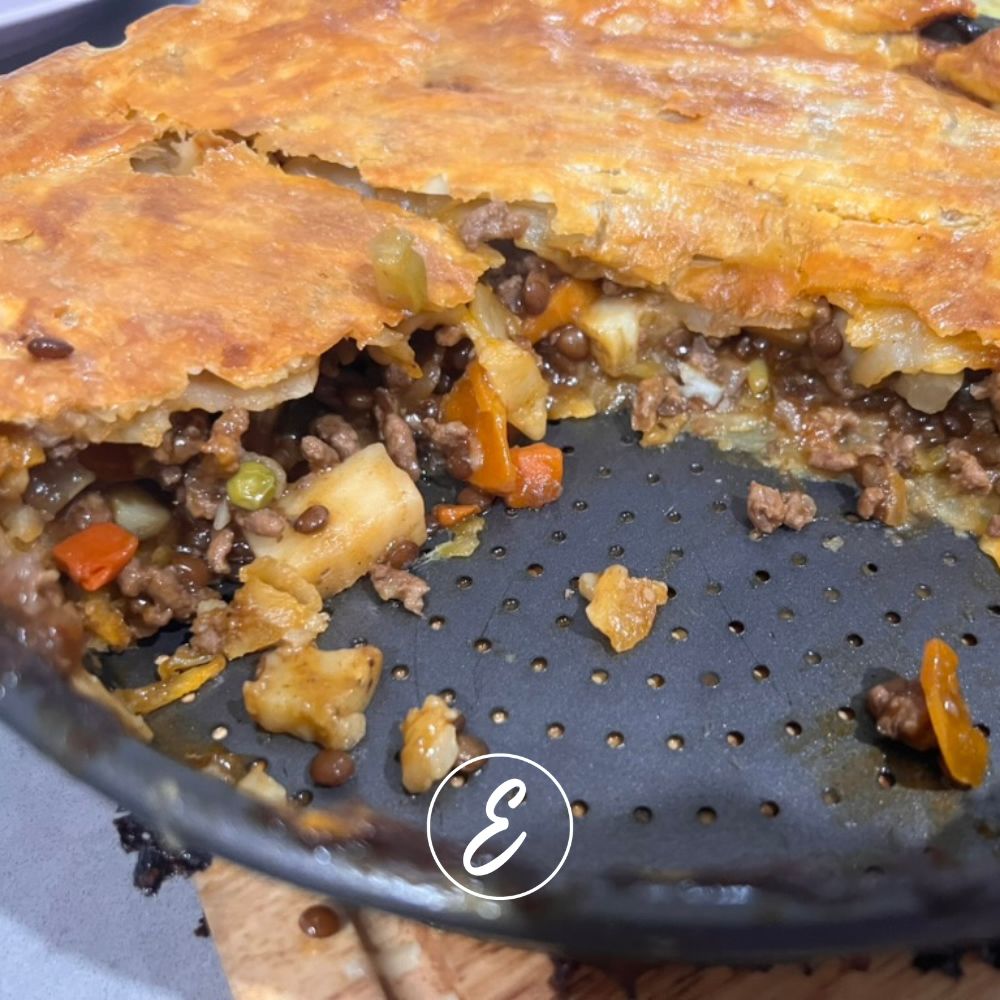
An easy homemade family pie with mince, lentils, vegetables and a proper pastry bottom. Because sometimes the best dinners happen when you’re too tired to follow a recipe.
It was Wednesday. I was tired.
Dinner needed making, but I didn’t particularly fancy spending the evening following a complicated recipe or washing seventeen different pans.
So I did what I often do when I can’t quite decide what to cook.
I opened the fridge, had a look through the pantry and asked myself one simple question:
What else could I add?
I started with some mince, onions and vegetables. Then came stock, a handful of lentils, some potatoes and a few more bits and pieces that needed using.
I let everything simmer away, slowly building flavour and allowing the sauce to reduce.
Eventually, I had a lovely, thick, savoury filling.
And since I had pastry in the freezer, it became a pie.
A proper pie, I might add. Pastry underneath AND on top.
By the time I’d remembered to take a photograph, a considerable portion had disappeared.
I think we can safely call that a successful Wednesday dinner.
What Else Can I Add? The idea behind this pie
This isn’t really about making one particular recipe.
It’s about learning how to turn a relatively small amount of meat into a substantial family dinner using ordinary ingredients.
Mince is wonderfully versatile, but it can become expensive when you’re relying on large quantities to feed everyone.
Instead, I like to build a meal around it.
Lentils add fibre, texture and bulk. Vegetables bring flavour, colour and variety. Potatoes make the filling more substantial while helping to thicken the sauce naturally.
And suddenly, the mince becomes one part of the meal rather than the entire meal.
It’s not about disguising vegetables or replacing everything with lentils.
It’s about asking what else could make dinner a little more nourishing, a little more economical and perhaps a little more interesting.
Start with what you’ve got
For this pie, I used a combination of:
- Mince
- Onion and garlic
- Carrots and other vegetables
- Lentils
- Potatoes
- Peas
- Stock or bone broth
- Shortcrust pastry for the base
- Puff pastry for the top
The exact quantities aren’t particularly important to the idea, provided you have enough filling for your pie dish and allow it to thicken before assembling.
You can use cooked lentils or properly prepared dried lentils, adjusting the liquid and cooking time accordingly.
And if you don’t have every vegetable on the list, don’t make a special shopping trip.
That’s rather the point.
How I made my Wednesday Night Pie
1. Start by building flavour
I began by sautéing the onion, garlic and vegetables that needed a little extra cooking.
Then I added the mince and cooked it through, breaking it up as it browned.
Nothing complicated, just the usual beginnings of a good savoury filling.
2. Add stock and let it simmer
Once everything had started cooking, I added stock.
If you have homemade bone broth, even better. It’s a lovely way to use something you’ve already prepared.
Then I turned the heat down and let the mixture simmer gently.
There’s no need to rush this part. The flavours develop as the liquid reduces, and you can add more ingredients along the way.
3. Ask: what else can I add?
This is where the pie started growing.
In went lentils, potatoes and a few extra vegetables.
The lentils helped stretch the mince, while the potatoes made the filling more substantial.
And there’s another reason I like adding potatoes to a pie filling.
As they cook, they release starch, which helps thicken the gravy naturally.
That means you don’t necessarily need to reach for flour or cornflour to thicken the sauce.
I continued simmering until the potatoes were tender and the filling was thick rather than watery.
4. Let the filling cool
This is worth remembering, particularly when you’re using pastry.
A very hot filling can soften the pastry before it has a chance to cook properly.
I prefer to let the mixture cool before assembling the pie, especially when I’ve made a lovely thick filling and don’t want to undo all that work.
5. Make it a proper pie
Now, I have a small confession.
I don’t consider a casserole with a pastry lid to be quite the same thing as a proper pie.
A pot pie has its place, of course, but I want pastry underneath as well as on top!
For this one, I used shortcrust pastry for the base and puff pastry for the top.
The shortcrust gives the filling a sturdy home, while the puff pastry creates that lovely golden, flaky top.
But please don’t feel you need to buy two different types.
If you’ve only got shortcrust or puff pastry, use what you have.
That’s the whole philosophy behind this meal.
My inexpensive secret to avoiding a soggy bottom
One of my favourite pieces of kitchen equipment is also one of the simplest.
It’s an inexpensive pie tin with little holes in the base.
Those perforations allow heat to reach the underside of the pastry and help moisture escape, making it easier to achieve a properly cooked base.
Combined with a thick filling, it makes a real difference.
I don’t need a fancy pie dish or a collection of specialist equipment.
Just a simple tin that does its job.
And honestly, if you’re going to make a pie, nobody wants a soggy bottom.
Three things that help
- Reduce the filling properly. Don’t pour a watery mince mixture into the pastry.
- Add potatoes. Their starch helps thicken the sauce as they cook.
- Use a perforated pie tin if you have one. It helps the bottom pastry cook more evenly.
I also allow the filling to cool before putting the pie together.
You can use an ordinary pie dish, too. A preheated baking tray underneath can help the base cook through.
What else could you add?
This is where the recipe becomes useful beyond one Wednesday dinner.
Depending on what’s in your fridge, freezer or pantry, you could try:
- Mushrooms: Finely chopped, they add a lovely savoury flavour.
- Celery: Particularly good sautéed with the onion and carrots.
- Frozen peas: Easy, inexpensive and no preparation required.
- Cooked lentils: A practical way to stretch mince and add fibre.
- Sweet potato: Adds a little sweetness and helps make the filling more substantial.
- Leftover roast vegetables: Chop them into smaller pieces and add them towards the end.
- Fresh herbs: Thyme, rosemary or parsley are all lovely additions.
You don’t need all of them.
Choose what works with the flavours you’re building and what needs using up.
You don’t need to start with a huge amount of meat
One of the easiest ways to reduce the cost of family dinners is to stop thinking of meat as the only ingredient that makes a meal substantial.
For a pie like this, the lentils, potatoes and vegetables are doing plenty of work.
They add different textures, nutrients and flavours, while allowing the mince to go further.
It’s a useful approach for bolognese, cottage pie, tacos, savoury mince and plenty of other family favourites.
Start with what you have, then ask what you could add.
You might be surprised how far it goes.
The best recipes aren’t always planned
By the time this pie came out of the oven, it was golden, generously filled and smelled wonderful.
And by the time I reached for the camera, much of it had already disappeared.
There wasn’t a complicated recipe behind it.
No expensive specialist ingredients.
Just a tired Wednesday evening, some ordinary food and a willingness to make a little go further.
That’s what I love about the What Else Can I Add? approach.
It takes the pressure off needing to cook something new and impressive every night.
Instead, it encourages us to use what we know, make the most of what we have and put a good dinner on the table.
And sometimes, that good dinner happens to be a rather magnificent pie.