Understanding your garden’s microclimate, why planting calendars don’t always work, and what my weather station is teaching me about growing food.
There are less than two weeks until summer officially begins in Australia, and I’m still growing snow peas and sugar snap peas.
Yes, snow peas.
Those lovely, crisp, cool-season vegetables that most gardening calendars suggest should be finishing up as the weather warms.
Meanwhile, here in my little corner of the Southern Highlands, they’re still happily growing.
I’m beginning to think my garden hasn’t received the memo that summer is coming.
But it raises an interesting question. Why can one gardener be harvesting tomatoes while another, not particularly far away, is still picking peas?
The answer is something I’ve become increasingly fascinated by: microclimates.
The Problem With Gardening Calendars
I love a good gardening calendar. They’re useful for planning, particularly when you’re starting out.
But there’s one rather important thing they can’t account for.
Your actual garden.
I live in Bundanoon, in the NSW Southern Highlands, where our growing seasons don’t always behave quite as the calendar suggests.
We can have bitterly cold winters, late frosts, strong winds and spring days that feel more like July than November.
In fact, we had a substantial frost as recently as 13 October.
That’s rather inconvenient when you’re trying to convince your summer vegetables that it’s safe to come outside.
Our spring can feel incredibly short. One minute I’m worrying about frost, and the next I’m wondering whether the greenhouse needs more ventilation.
And yet, here we are in November, with snow peas and sugar snaps still growing.
The lesson? A planting calendar is a guide, not a guarantee.
My Microclimate
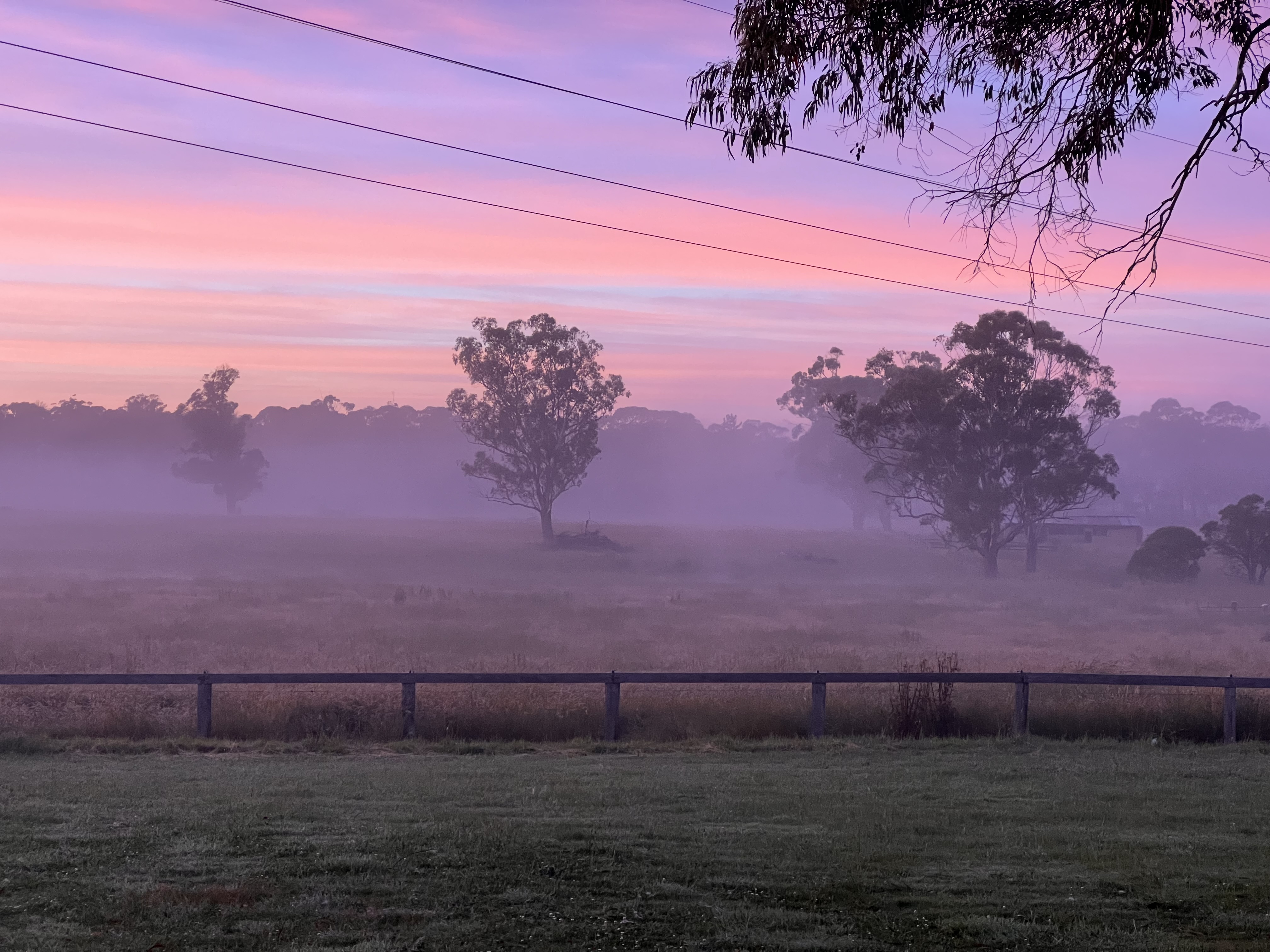
This morning, I stepped outside to find the paddocks covered in mist beneath the most extraordinary pink and purple sky. Dew was sitting on the grass, and the garden still had that cool, damp feeling I associate more with early spring than the approach of summer.
A little later, the sunshine arrived, and there were my snow peas and sugar snaps, still flowering and producing pods.
It’s a perfect example of why I pay so much attention to our microclimate. The season might say one thing, but the conditions outside my back door tell a rather different story.
Of course, the two rabbits I discovered in the garden this morning appear to have decided it’s an all-you-can-eat buffet. So understanding the weather is only half my problem. Apparently, I also need to reinforce the fence.
What Exactly Is a Microclimate?
A microclimate is the climate of a particular small area, which can differ from the conditions in the surrounding region.
And you don’t need a large property to have one.
Even an ordinary suburban garden can contain several different microclimates.
The sunny, sheltered spot beside your house might be considerably warmer than the exposed vegetable bed at the bottom of the garden.
A south-facing corner might remain cool and damp, while a north-facing wall absorbs warmth throughout the day.
Trees, fences, buildings, slopes and even the type of soil can influence growing conditions.
Some of the most important factors include:
- Temperature: How warm or cold your particular growing area becomes.
- Frost: Whether cold air settles in certain parts of the garden.
- Wind: How exposed your plants are to drying or damaging winds.
- Sunlight: How many hours of direct sunshine each bed receives.
- Rainfall and moisture: How much water reaches the soil and how quickly it dries out.
Two gardens in the same town can experience surprisingly different growing conditions.
And even two beds in the same garden can behave differently.
My Southern Highlands Garden Has Its Own Ideas
Gardening here has taught me to be rather flexible.
Our winters are long, and spring often seems reluctant to arrive.
We’ve had winds approaching 100 km/h, late frosts and stretches of cool, overcast weather when everything seems to grow at a snail’s pace.
Then the temperature rises, and suddenly the entire garden wants attention at once.
My snow peas and sugar snaps are a perfect example of how the growing season can stretch beyond the dates printed on a seed packet.
Peas generally prefer cooler conditions. Once temperatures become consistently hot, flowering and pod production often slow down, and the plants eventually decline.
But if the weather remains relatively mild, they may continue producing much later than expected.
That doesn’t mean everyone in Australia should be planting snow peas in November.
It means what’s happening in your own garden matters more than what month it is.
And that is why I’ve started paying much closer attention to our local weather conditions.
Why I Got a Weather Station for My Garden

Rather than relying entirely on the weather forecast for the nearest town, I wanted to understand what was actually happening at home.
So I bought a VEVOR weather station, actually my husband bought me it – perhaps I was annoying him reading too many weather apps!
Not because I have aspirations of becoming the next television weather presenter, but because I wanted better information for growing food.
The station helps me monitor local conditions, and I’m particularly interested in temperature, rainfall and wind.
These measurements are useful for understanding the broader patterns affecting my garden.
For example, I can start comparing the temperatures we’re experiencing with how particular crops are performing.
I can observe whether strong winds coincide with stressed seedlings or drying soil.
And over time, I can build a clearer picture of when our growing season really begins and ends.
There is one important distinction, though.
A weather station measures conditions where its sensors are installed. It won’t automatically tell you the temperature in every sheltered corner or frost pocket of your garden.
For that, you need observation, and sometimes additional thermometers in different growing areas.
But it’s an excellent starting point.
What I’m Learning to Watch
1. Overnight temperatures
These are particularly important in spring when tender seedlings may be vulnerable to frost.
A sunny afternoon doesn’t necessarily mean a warm night is coming.
2. Wind speed
Strong winds can damage plants, dry out soil and make newly transplanted seedlings struggle.
Our Southern Highlands winds can be rather enthusiastic, so understanding exposure is especially useful.
3. Rainfall
A little rain doesn’t necessarily mean the soil has received enough moisture.
Tracking rainfall alongside checking soil moisture helps me make more informed watering decisions.
4. Seasonal patterns
This is the part I’m most interested in.
One unusual spring doesn’t establish a reliable growing pattern. But recording conditions over several seasons should help me understand what works in our particular garden.
And that’s information I can use when planning future crops.
Five Ways to Understand Your Own Garden’s Microclimate
You don’t need to rush out and buy a weather station to start understanding your garden.
A notebook and a little observation can tell you an enormous amount.
1. Record your first and last frosts
Don’t rely solely on regional averages.
Write down when frost actually occurs in your garden, particularly when it damages tender plants.
Over several years, this will help you understand your local frost risk.
2. Watch where the sun falls
Notice which beds receive morning sun, afternoon sun or prolonged shade.
Remember that the sun’s position changes throughout the year.
A wonderfully sunny bed in summer might receive very little direct light in winter.
3. Identify your sheltered and exposed areas
Look at where wind hits hardest and where fences, hedges or buildings offer protection.
Sheltered areas can be useful for establishing tender plants, although enclosed spaces can sometimes trap cold air too.
4. Pay attention to your soil
Soil temperature and moisture can influence germination and growth just as much as air temperature.
Wet soil may remain cooler for longer, while raised beds can warm more quickly in spring.
5. Keep a simple growing diary
Record what you plant, when it germinates, when it starts producing and when it finishes.
Include unusual weather events.
You don’t need an elaborate spreadsheet.
Although, knowing me, I’ll probably end up with one.
What Does This Mean for Planting Vegetables?
It means we can start making decisions based on actual growing conditions rather than treating planting dates as fixed rules.
For example:
Cool-season vegetables: Snow peas, sugar snaps, broad beans and leafy greens may continue producing while temperatures remain favourable.
Warm-season vegetables: Tomatoes, cucumbers, chillies and zucchini generally need warmer conditions, particularly for establishment and growth.
Tender seedlings: Even when daytime temperatures are pleasant, cold nights and exposed positions can slow growth or cause damage.
This doesn’t mean ignoring seasonal advice altogether.
It means combining that advice with what you learn about your own garden.
A seed packet gives you a starting point.
Your garden gives you the evidence.
From Garden Observations to Growing More Food
One of my longer-term goals is to grow much more of the food we eat as a family.
And as I plan the productive gardens at Jaspire Estate, understanding microclimates is becoming increasingly important.
Where should the more frost-sensitive crops go?
Which areas need wind protection?
Where will a greenhouse be most effective?
Which vegetables might benefit from cooler conditions, and where can I extend the growing season?
These are all questions that become easier to answer when you have a better understanding of your local environment.
I’m not expecting a weather station to solve every gardening problem.
If only.
But combining local weather measurements with hands-on experience should help me make better decisions and, hopefully, grow more food with fewer disappointments.
So, Why Am I Still Growing Snow Peas in November?
Because my garden is experiencing conditions that are still allowing them to grow.

It’s as simple — and as complicated — as that.
The calendar says summer is nearly here.
My snow peas apparently disagree.
And rather than worrying that my garden isn’t following the rules, I’m learning to pay attention to what it’s telling me.
Because successful food gardening isn’t about following every instruction perfectly.
It’s about understanding your conditions, experimenting, learning from what works and adapting when things don’t.
Grow food that works for your garden, not just your gardening calendar.
And if you’re still harvesting snow peas in November too, I’d love to know where you’re growing them.
Perhaps we can start a little club.
The Summer Snow Pea Society has a rather nice ring to it.